While musically satisfying, the second “Wicked” movie just wasn’t as good as the first. Jon M. Chu’s “Wicked: For Good,” the second installment in his adaptation of the Broadway musical, came out on November 21st, just last Friday. I went and saw it on Saturday, so here are some of my thoughts.
This review contains spoilers for the 2024 film “Wicked”, as well as the novel and musical, so beware if you haven’t seen them.
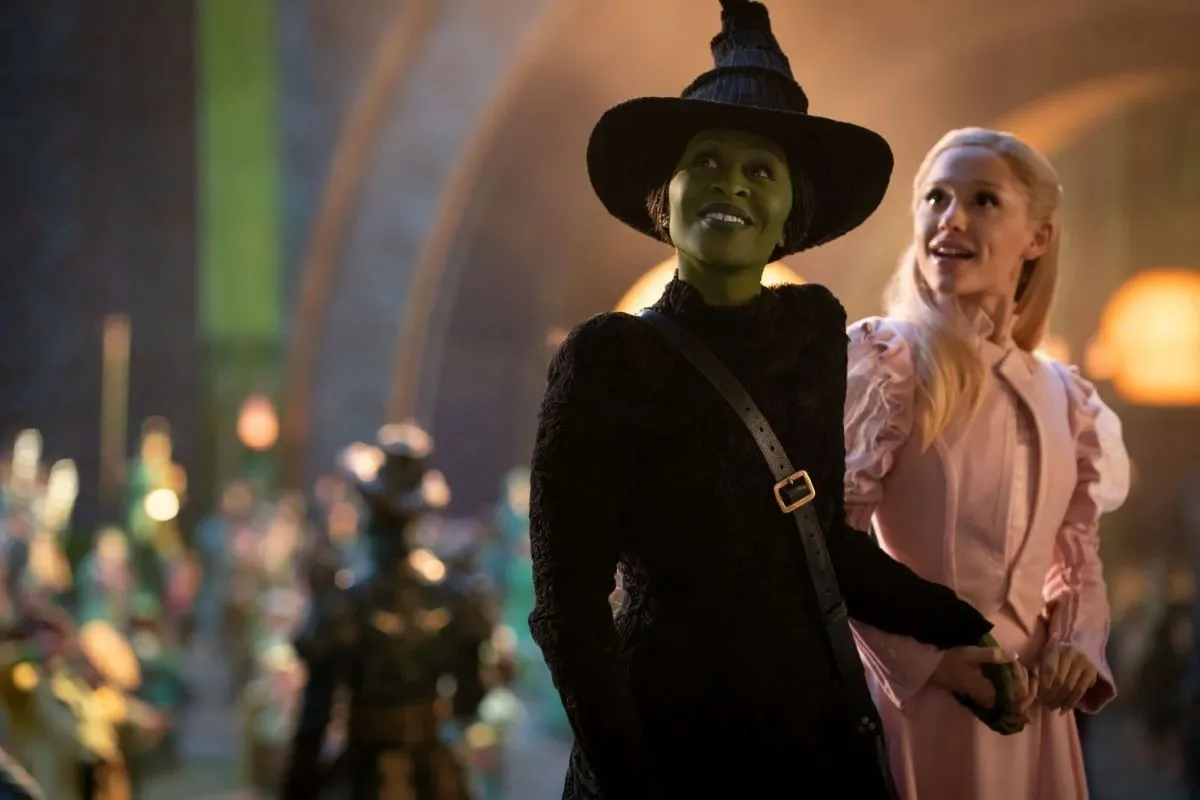
“Wicked: For Good” picks up some unknown number of years after the first “Wicked” ends. Glinda (Ariana Grande) still resides comfortably in the Emerald City, unable to resist the Ozians’ adoration. Meanwhile, her supposed best friend Elphaba (Cynthia Erivo), the ‘Wicked Witch of the West’, lives in hiding, liberating oppressed animals while hunted by flying monkeys controlled by Madam Morrible and the Wizard.
While “Wicked” focused mainly on Elphaba and Glinda’s developing friendship and coming of age, “Wicked: For Good” has a darker tone, paying greater attention to the rights of animals being taken away by an increasingly fascist Ozian government and the protagonists’ struggle against it.
The high point of the film for me was easily “No Good Deed,” Erivo’s solo song in which Elphaba swears she will never do a good deed again, as “no good deed goes unpunished.” Erivo’s singing voice is incredibly powerful, soaring above this piece’s orchestral score. Both Erivo and Grande insisted on singing live during filming, making this even more impressive.
Ariana Grande also portrays Glinda’s inner conflict convincingly in “Thank Goodness / I Couldn’t Be Happier” and “The Girl in the Bubble,” both songs where Glinda struggles between her perfect public persona and her contradicting feelings about Fiyero and Elphaba. Other notable performances came from Ethan Slater’s surprisingly scary Tin Man and Michelle Yeoh’s Madam Morrible.
For me, where this film goes wrong is the plot and pacing. The second act of the Broadway version of “Wicked” has long been criticized for this same reason, and the movie unfortunately does not avoid it. The songs are lengthened for the movie, yet the scenes in between are so rushed that nothing that happens in the songs gets to rest.
For example, Elphaba sings the song “No Good Deed,” where she vows to truly be a wicked witch, and then makes up with Glinda after what seems like five minutes. Though the song did sound beautiful, the impact of it is lessened because it seemed like it didn’t actually lead to any changes. The most “wicked” thing Elphaba does, which is to send the monkeys to kidnap Dorothy for her shoes, happens in about two minutes and has no real consequences for her.
Choices like this seem even stranger when you notice that while Elphaba’s story seems rushed, extra songs like “The Girl in the Bubble, which didn’t even exist in the original musical, were added to further Glinda’s character development. Again, a beautiful song, but it slows the movie down at a weird time, and not for something so memorable as “Defying Gravity” in the first act.
Now, I don’t think these problems would necessarily be obvious to any casual moviegoer. In fact, I think the performances of the musicians alone are good enough to overlook them entirely. It’s definitely an entertaining movie, and you will undoubtedly leave the theater impressed. However, in my opinion, the first “Wicked”’s superior plot and catchier songs make it a much more enjoyable watch.